
Gdp Growth by State
Discover insights about growth state and their relevance in today's dynamic business environment.
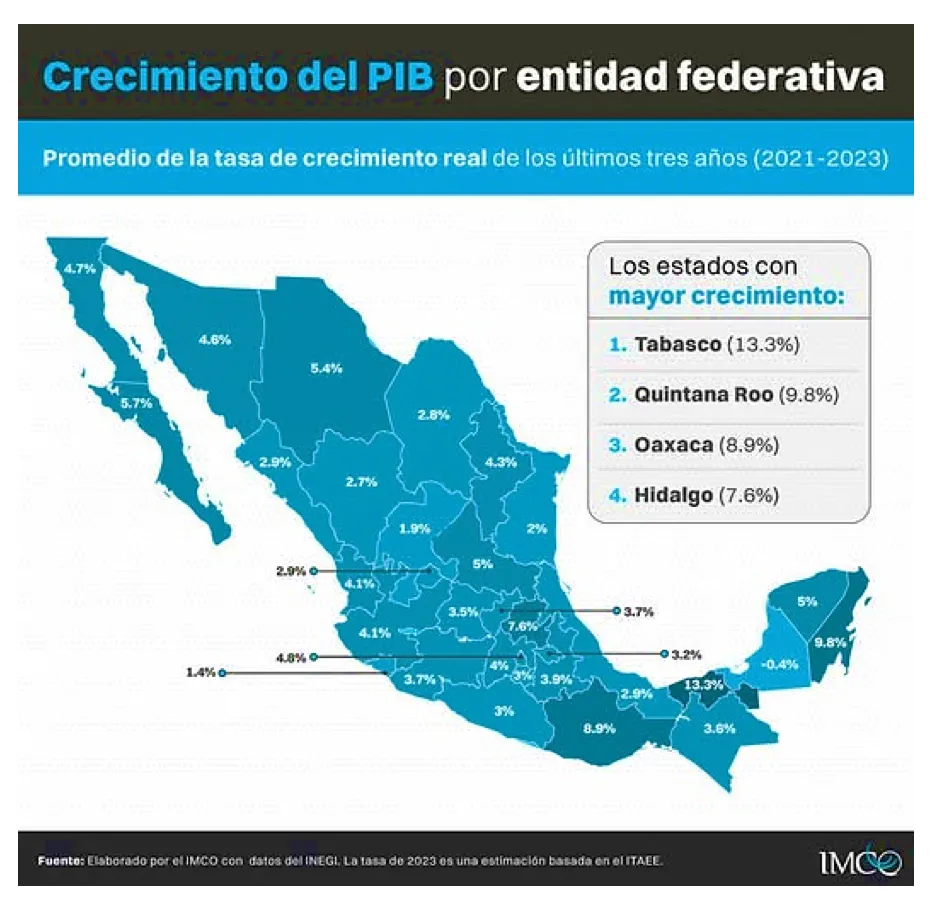
IMCO conducts the ICE to evaluate the strengths and weaknesses of the 32 federal entities. Meanwhile, the GDP by state reflects the economic output of each region. With data from the latest ICE, an asymmetrical growth of GDP in Mexican states can be seen.
In fact, the GDP of the second quarter grew 0.2% quarterly. Annually, it increased 1.0%, below the preliminary 1.1%. In the first half of the year, the accumulated growth is 1.4%. Activities (quarterly rate): primary -0.2%; secondary +0.3%; tertiary +0.1%.
The states with the highest growth in the last three years evaluated are:
- Tabasco 13.3%.

- Quintana Roo 9.8%.

- Oaxaca 8.9%.

- Hidalgo 7.6%.
But for ICE purposes, they are in 15th, 20th, 25th, and 32nd place in State Competitiveness.
Gdp Growth in the Regional Neighborhood1066
In the regional neighborhood, San Luis Potosí has the highest GDP growth with 5%, surpassing Jalisco and Nuevo León, which are reported with 4.3%. They are followed by Querétaro and Guanajuato, with growth of 3.7% and 3.5%, respectively. Aguascalientes and Zacatecas have lower GDP growth, with percentages of 2.9% and 1.9%, respectively.
For the ICE, the order is different: Nuevo León, Querétaro, and Aguascalientes are in better places (4th, 5th, and 6th) than San Luis Potosí, Guanajuato, and Zacatecas (18th, 22nd, and 27th).
Mexico’s Gdp Growth1656
In 2025, forecasts on GDP growth in Mexico are varying, with some analysts reducing their expectations and others maintaining more optimistic projections. In general, modest growth is expected, with estimates between 0.11% and 1.4%.
Mexico’s GDP in 2025 is projected at 30.5 trillion pesos at current prices and 25.6 trillion pesos at constant prices, according to the 2025 Economic Package. This economic package comprises a series of financial initiatives, including: the federal budget, the Federal Revenue Law, and the Federal Expenditure Budget Law. Public spending is estimated to increase by 8.8% compared to 2024, reaching 291.525 billion pesos.
IMCO, in analyzing this budget and its implications for the Mexican economy, highlights the importance of efficient management of public resources to maximize the impact on the quality of life of the population.
More Articles

Manufacturing Sustains Employment in Nuevo León: Which Sectors Drove Growth?
Sep 2, 2026
Trump Raises Tariffs on Canadian Autos and Steel: Implications for Mexico and USMCA
Aug 24, 2026

Strategy Launched to Enable Businesses in San Luis Potosí to Sell on TikTok
Aug 19, 2026

Querétaro Surpasses 10% Growth in Automotive Parts Production
Sep 8, 2026
Nissan CEO Iván Espinosa Reportedly to Visit Aguascalientes Plants
Aug 20, 2026

Who Could Be Left Incommunicado This Weekend If They Don't Register Their Phone Line?
Aug 14, 2026