
AI No Longer Lives in Chat: It's Now Working Within Your Company's Tools
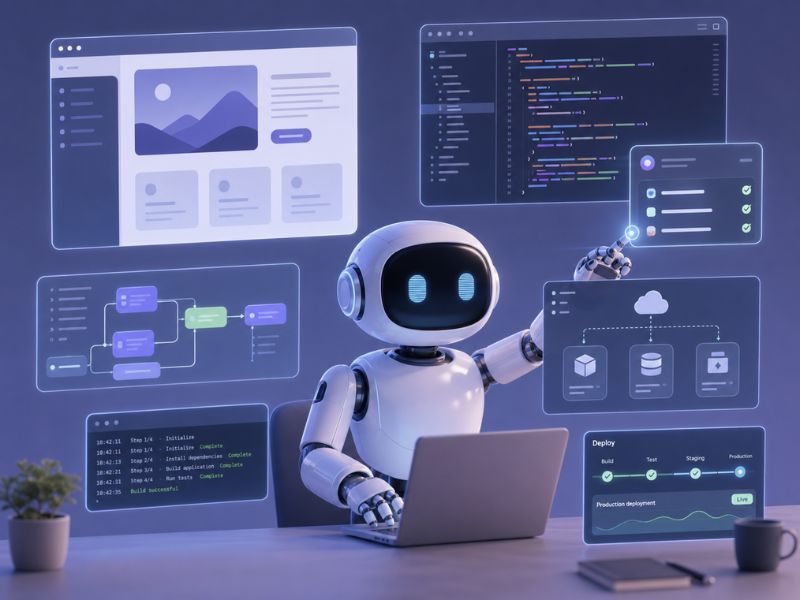
Explore how AI is moving beyond chatbots to become an integrated part of daily business operations and technological stacks.
By Alan Gibrán Ávalos Hernández — CEOS Lógica
For a long time, enterprise artificial intelligence (AI) was understood as a chat window. The ritual was well-known: open a tab, type a question, copy the answer, paste it into a document, correct it, move it to a presentation, send it via email, and then repeat the process for another task. That was helpful. For many, it was even revelatory. But it also created an incomplete picture of what AI could achieve within a company.
Because there’s a difference between having an AI that answers and having an AI that works on the tools where daily operations already reside.
This is the shift that many business leaders have yet to fully grasp. The new generation of AI doesn’t want to stay in the chat. It wants to enter documents, spreadsheets, CRMs, emails, calendars, project managers, customer service systems, code repositories, browsers, shared folders, and the applications your company already uses daily.
The conversation is no longer: “What can I ask ChatGPT?” The conversation is beginning to be: “What parts of my operations can I delegate to agents connected to my technology stack?”
The Misconception: Believing AI is Still Just a Prompt-Writing Screen
Many executives still imagine AI as an external assistant. A useful tool for drafting text, summarizing documents, generating ideas, or correcting emails. And yes, it can do all of that. But to limit it to that in 2026 is like having only used the internet for sending emails in 2005.
AI has ceased to be solely a conversational interface. It is now becoming an execution layer. Microsoft Copilot no longer just answers questions; it can help create documents, spreadsheets, and presentations within the Microsoft 365 ecosystem. Gemini is already integrated into Google Docs, Sheets, Slides, Drive, and other Workspace applications. Claude, Codex, Copilot Studio, and other systems are starting to connect with enterprise tools via APIs, connectors, and protocols like MCP.
That last point is key. MCP, the Model Context Protocol, can be understood as a sort of standard port for AI agents to connect with external tools. It’s not magic. It doesn’t mean AI can do anything without configuration, permissions, or supervision. But it does signal a clear direction: agents are moving from being isolated assistants to connected operators. In simple terms: AI can now have hands within your software.
What Used to Be “Copy and Paste” Is Now Becoming Workflow
Let’s consider a common task: preparing a monthly performance presentation. Previously, someone had to review emails, open a spreadsheet, update figures, copy charts, write conclusions, assemble slides, check style, and send the file.
With traditional conversational AI, part of the work could be accelerated. For example, asking it to draft a conclusion or suggest a structure.
With connected agents, the scenario begins to change. The agent can read files, review available information, generate a first draft of the document, structure a presentation, interpret data, and prepare deliverables within the same tools the team already uses.
The same applies to a spreadsheet. AI no longer just explains a formula; it can help organize data, identify patterns, clean information, build tables, or prepare analyses.
The same happens with customer service. An agent connected to Intercom can retrieve conversations, contacts, and customer context.
- One connected to Zoho can operate on CRM, calendar, billing, tasks, or sales flows, depending on its configuration.
- One connected to Slack can query internal information.
- One connected to Google Drive can search for documents.
- One connected to a code repository can review an application.
The difference is enormous. A chatbot responds from the outside. An agent works from the inside.
Claude Code and Codex Are the Most Visible Signal, But Not the Only One
Claude Code and Codex have garnered significant attention because they demonstrate this transition in the software world. The former can work on codebases, edit files, execute commands, review errors, and advance technical tasks. Codex can read, edit, and execute code, integrate with IDEs, work with cloud environments, and operate with workflows increasingly close to real development.
But it would be a mistake to think this only matters to programmers. The software world is seeing a transformation first, which will then extend to other areas: sales, finance, operations, human resources, customer service, marketing, and general management.
Why? Because programming is a very visible way of working with tools, files, decisions, tests, and deliverables. But an entire company functions this way.
A quote is also a deliverable. A financial report is also. A sales presentation is also. A customer response is also. A sales follow-up is also. A reconciliation is also. Meeting minutes are also. A KPI dashboard is also. A campaign is also.
The logic of agents is not limited to code. It extends to any process where data, tools, rules, and repeatable actions exist.
The Real Change: AI Is Starting to Touch the Technology Stack
Every company has a stack, even if they don’t call it that. It could be Microsoft 365, Google Workspace, Zoho, HubSpot, Odoo, Monday, Notion, Slack, Intercom, WhatsApp Business, Shopify, WordPress, Contpaqi, Dropbox, Drive, spreadsheets, and a set of legacy systems that no one wants to move because “it’s always worked that way.”
That collection of tools is where the real operation lives. The problem is that, in many companies, this stack is fragmented. Information lives in silos. Sales has one part. Administration has another. Management requests reports that someone manually compiles. Customer service knows things that don’t reach the CRM. Operations solves problems in chats. Important files are scattered across folders, emails, and personal computers.
For years, the solution was to buy more software. Another CRM. Another dashboard. Another automation platform. Another reporting system.
The new question is different: What would happen if a layer of agents could move between these tools, read context, execute tasks, and maintain continuity between processes? That’s where applied AI is truly becoming enterprise-grade. Not because it replaces all existing systems, but because it can act as a coordination layer over them.
From Rigid Automation to Agents with Context
Traditional automation works very well when the process is stable: if A happens, do B. If an email with a certain word arrives, create a task. If a form is filled out, send a notification.
But many real-world operations are not so clean. Customers write differently. Files arrive incomplete. Salespeople capture data incorrectly. Suppliers change formats. Screens update. Systems lack APIs. Exceptions are more common than the rule.
That’s where agents begin to make sense. An agent doesn’t just execute a fixed recipe. It can interpret context, decide which tool to use, ask for confirmation when it detects risk, compare information, generate a draft, classify requests, prepare a response, or escalate a case.
For example:
- A sales agent can review new leads, check customer history, prepare a follow-up email, and schedule a call.
- A support agent can read previous conversations, identify urgency, classify tickets, and suggest the next action.
- An administrative agent can extract data from invoices, cross-reference it with a spreadsheet, and prepare a report.
- A management agent can gather information from documents, emails, and presentations to prepare a briefing before a meeting.
- A technical agent can review an application, fix a minor error, and have the change ready for review.
This is no longer “prompt engineering.” It’s designing agent-assisted work.
The Part Many Aren’t Seeing: It’s Already Entering Through the Tools They Use Daily
The adoption of enterprise AI will not necessarily happen as many imagined. It won’t always come with a large digital transformation project. It won’t always start with a massive consulting engagement, nor will it require the company to develop its own platform from scratch.
In many cases, it will enter through the doors that are already open.
- Through Microsoft 365.
- Through Google Workspace.
- Through the CRM.
- Through the support system.
- Through the browser.
- Or email.
- Through the code editor.
- Through the spreadsheet.
- Through the presentation app.
- Through the task manager.
The executive who believes their company “doesn’t use AI yet” might be in for a surprise. Perhaps their team is already using Copilot to prepare presentations. Maybe someone is already using Gemini in Docs to draft proposals. Perhaps a technical area is already testing Codex or Claude Code. Or sales is already connecting AI with the CRM. Maybe Customer Service already has an automation layer that no one in Management has formally evaluated.
AI can enter through productivity before entering through strategy. And that creates a risk: adoption may occur without methodology, without rules, without data criteria, and without a shared vision.
The Opportunity: More Capability Without Multiplying Structure
For small and medium-sized businesses, this transition is especially important. For years, many Mexican SMEs have had a gap that’s difficult to close: they need to operate like more sophisticated companies, but they can’t always hire large teams for technology, analytics, automation, design, reporting, or development.
Agents don’t completely eliminate that gap, but they can reduce it. A small team can produce better reports. A sales area can provide better follow-up. Operations can be better documented. A manager can prepare more complete analyses. A company can prototype internal tools without waiting months. An executive can have more visibility without asking three people to compile a manual report.
The real promise is not “doing more with less” as a consulting phrase. The real promise is reclaiming hours trapped in tasks that shouldn’t depend on copying, pasting, searching, sorting, and repeating. That’s where the accounting value of agents lies. Not in them being surprising. Not in them writing beautifully. Nor in them seeming intelligent. But in their ability to move work forward.
But the Company Needs Governance Before Opening All Doors
The other side of this story is equally important. If an agent can read files, query customers, modify records, send emails, create documents, operate interfaces, or touch internal systems, then the conversation is no longer just about productivity. It’s about governance.
- What information can it access?
- What actions can it execute without approval?
- What data should not leave the organization?
- What tasks require human supervision?
- What tools connect, and which ones don’t?
- Who reviews the errors?
- Where is a record kept of what it did?
- What happens if it makes a wrong decision?
A company that ignores these questions may move fast, but it may also open doors it later won’t know how to close. That’s why new AI leadership isn’t about permitting everything or blocking everything. It’s about designing intelligent adoption. First, diagnose. Then, prioritize processes. After that, define tools. Later, establish rules. Finally, scale with measurement and supervision. Applied AI is not about testing what’s trendy. It’s about building organizational capacity.
The Conversation Worth Having Now
The central point for a Mexican entrepreneur in 2026 is this: AI is no longer an external tool to operations. It’s entering the heart of the technology stack.
- Copilot in Microsoft 365.
- Gemini in Google Workspace.
- Claude and Codex in technical environments.
- MCP connects agents with business tools.
- Zoho, Intercom, Slack, CRM, support, documents, spreadsheets, and internal systems are becoming actionable by AI.
The question is no longer whether your team should learn to write better prompts. That was the first stage. The question now is more strategic: what processes in your company can be assisted, accelerated, or partially executed by agents connected to your real work tools? And, above all, who within the organization will have the judgment to decide? Because AI that answers improves conversations. AI that executes changes processes. And AI connected to the technology stack begins to change companies.
You don’t need to wait five years for this to arrive. It’s already appearing within the applications your team opens every day. The advantage will not go to those who install more tools. It will go to those who first understand how to turn them into method, governance, and results.
This will be one of the central themes of the Applied AI Masterclass for Businesses: how to move from using AI as a chatbot to understanding it as a layer of agents connected to the organization’s real tools. We will review practical cases, risks, adoption criteria, governance, and a 30/60/90-day roadmap to start with methodology. https://masterclassia.ceoslogica.com/ The post
first appeared on Líder Empresarial.
More Articles

Women in Querétaro Manufacturing: The Challenge Isn't Entry, It's Growth
Jun 8, 2026

Why Querétaro Attracts More Talent and Investment Than Other Mexican Cities
Jun 16, 2026
What is Codex and Why is OpenAI Developing It Beyond a Programming Assistant?
Jun 19, 2026

San Luis Potosí Ranks Seventh Nationally in Foreign Investment Attraction in 2026
May 26, 2026

SpaceX Debuts on Wall Street: What Are the Stock Prices?
Jun 12, 2026

Is There a Fuel Shortage in Jalisco?: Pemex Responds
May 26, 2026