
From Digital AI to Physical AI: Humanoids
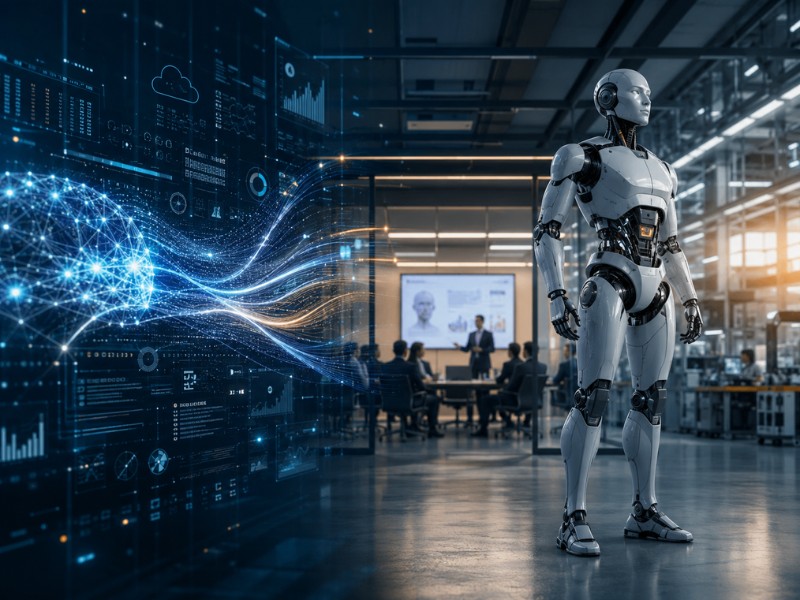
Exploring the profound shift from AI confined to screens to intelligent machines capable of interacting with the physical world.
From Digital AI to Physical AI: Humanoids
For the past few years, business conversations about artificial intelligence have focused on the digital realm: conversational assistants, email automation, data analytics, content generation, AI agents, copilots, chatbots, intelligent search engines, and models capable of reasoning over vast amounts of information. This stage remains profoundly important. In fact, many Mexican companies are just beginning to organize their processes, data, and teams to seriously leverage generative AI. However, while a significant portion of the market is still grappling with how to use a digital copilot, the next technological wave has already begun to move beyond the screen.
Artificial intelligence is gaining a physical form. This is the essence of the conversation around humanoid robots. We are not just talking about human-shaped machines or spectacular videos designed to grab attention on social media. We are talking about a deeper transition: moving from AI that writes, recommends, analyzes, and converses, to AI that can also walk, carry, inspect, manipulate, sort, assemble, assist, and eventually operate in physical spaces designed for humans. This new frontier is being called physical AI. And while there is still much enthusiasm, many promises, and also considerable hype, it would be a strategic mistake to ignore it. Companies that are today learning to use digital AI to improve processes, reduce friction, and make better decisions will tomorrow have to ask themselves a much more concrete question: what part of physical work can also be assisted, automated, or redesigned by intelligent systems?
AI No Longer Just Responds: It’s Starting to Act
The difference between digital AI and physical AI seems simple, but it changes everything. A digital AI can draft a proposal, analyze a database, summarize a meeting, generate a business plan, or help a sales team prioritize prospects. Its impact is primarily in the realm of information. A physical AI, on the other hand, must understand its environment, move within it, recognize objects, calculate distances, manipulate materials, avoid accidents, respond to people, and adapt to changing situations. That is much more difficult.
On a computer, an error might result in a wrong answer. In a factory, a warehouse, a kitchen, a hospital, or a home, an error can lead to a fall, a collision, damaged equipment, operational disruption, or risk to a person. This is why the advancement of humanoids should not be analyzed solely as a technological novelty, but as a new stage in the relationship between intelligence, work, and productivity. Today, the main use cases are not in the home, although that is where much of the public imagination is focused. The first truly promising scenarios are in manufacturing, logistics, distribution centers, inspection, material handling, and repetitive tasks in industrial environments. The reason is clear: in these spaces, there are measurable processes, structured tasks, easier-to-calculate ROI, and a constant need for productivity.
2026: From Prototype to Industrial Pilot
The year 2026 is solidifying as a turning point for humanoid robotics. Not because we will be surrounded by robots, but because leading companies are beginning to move beyond the demonstration stage into a more demanding phase: limited production, customer pilots, in-plant testing, and accumulation of real operating hours. Figure AI, one of the most visible companies in the sector, reported that its BotQ plant transitioned from producing one Figure 03 robot per day to one per hour, with over 350 units manufactured and a 24-fold improvement in productivity in less than 120 days. This data is relevant because the challenge is no longer just designing an impressive robot, but manufacturing it consistently, with controlled costs, and with the capacity for continuous improvement. The same company announced tests of the Figure 03 at BMW’s plant in Spartanburg, connecting its robot with manufacturing logistics and material handling tasks. The narrative is no longer limited to “look how it walks,” but to “look how it can be integrated into a real operational flow.”
Boston Dynamics, for its part, is bringing Atlas to a more commercial stage. Its new generation is oriented towards applications such as parts sequencing, machine tending, and order picking. Furthermore, it announced an alliance with Google DeepMind to integrate foundational AI models, including Gemini Robotics, into its Atlas robots. Apptronik has also made significant moves. In 2026, it announced a Series A funding round exceeding $935 million, including an extension of $520 million, to accelerate Apollo production and expand commercial pilots in retail, manufacturing, and logistics. What these movements have in common is very important: humanoids are entering a phase where the market is beginning to demand less spectacle and more operational capability.
China Aims to Scale First
In this race, China deserves special attention. According to information published by official Chinese media, the country’s humanoid robot production could exceed 100,000 units in 2026. That number should be read carefully. It does not mean all these robots will be working with full autonomy in factories or homes. But it does show an industrial intent: to make humanoid robotics a scaled production chain. China has evident advantages: electronics manufacturing, batteries, actuators, sensors, industrial suppliers, and a massive capacity for iteration. If it succeeds in lowering costs and accelerating deployments, it could become the player that transforms humanoids from experimental products into equipment available for multiple industries. More aggressive tests are also emerging. Agibot, for example, was reported in an industrial test where eight G2 robots worked for over 64 cumulative hours across six days, participating in inspection and manipulation during the manufacturing of 17,625 tablets, with a reported success rate of 99.99%. This figure should be taken as reported data, not as an independent audit, but it shows where the competition is heading: more real-world hours, more repeated tasks, more integration with production lines.
The Real Bottleneck Isn’t Walking, It’s Manipulating
When we see a humanoid, we tend to focus on whether it walks well, climbs stairs, or moves similarly to a person. But the major business challenge lies in the hands. Manipulating objects is far more difficult than it appears. Picking up a box, opening a door, sorting a part, folding fabric, carrying an irregularly shaped component, arranging a fragile product, or inserting a part into an assembly line requires vision, controlled force, balance, spatial memory, and real-time adaptation. In other words: the robot doesn’t just need to move. It needs to understand what it’s doing.
This is why vision-language-action models are becoming so relevant. Figure, for example, has shown progress with Helix 02, a system that aims to control the robot’s entire body based on visual perception and learning, integrating locomotion, manipulation, and balance. The company reported a four-minute autonomous task in a kitchen, unloading and loading a dishwasher without human intervention. These types of advances should not be interpreted as robots being able to perform any domestic task. Rather, they indicate that the industry is solving pieces of the puzzle: perception, control, memory, manipulation, balance, learning, and adaptation. The big question is when these pieces can be reliably integrated into real environments, at reasonable costs, and without constant supervision.
Safety: The Issue Separating Demos from Business
In digital AI, one of the big debates is trust: can I trust the answer? Where did the information come from? What happens if the model makes a mistake? In physical AI, trust becomes more delicate: can I trust that the robot won’t hit a person? What happens if it loses its balance? How does it stop? What happens if a camera fails? How is a physical decision made by a probabilistic system audited? Safety will be one of the most significant barriers to adoption. NVIDIA is understanding this and in 2026 announced Halos for Robotics, a full-stack safety platform for humanoid and industrial robots, from silicon to software. Agility Robotics, with its Digit robot, appears as one of the first integration cases for work in logistics, manufacturing, and warehouses. This point is fundamental for entrepreneurs: the value of a robot will not be measured solely by what it can do, but by what it can do safely, repeatably, certifiably, and economically justifiably. In a company, innovation that cannot be operated remains a demonstration. And technology that cannot be governed becomes a risk.
Will They Replace Workers?
The question is inevitable, but it’s worth framing it better. It’s not just about asking if robots will replace people. The strategic question is: which tasks will change owners, costs, risks, or speed when AI can act physically? In many industries, humanoids will not appear first to completely substitute jobs, but to absorb repetitive, dangerous, high-turnover, or hard-to-fill tasks. Loading, inspecting, moving, sorting, feeding a line, patrolling spaces, operating extended hours, or supporting logistics processes. But it would also be naive to deny that there will be labor impacts. As happened with industrial automation, enterprise software, and now generative AI, each technological leap redistributes value. Some tasks lose relevance, others transform, and new ones emerge.
The opportunity for companies is not to think solely about headcount reduction, but about redesigning entire processes. Those who use humanoids solely to replace a human task may see limited savings. Those who integrate them into a broader architecture of data, operations, maintenance, security, and business intelligence will be able to capture much more value.
From Digital Copilots to Physical Companions
In my conversations with entrepreneurs, executives, and work teams, I often emphasize one point: AI should not be understood as an isolated tool, but as a new layer of operation. First came the digital layer: copilots, automations, agents, predictive analytics, content generation, intelligent search, customer service, documentation, and assisted decision-making. The next layer will be physical: machines capable of connecting with work orders, inventories, routes, operational dashboards, sensors, cameras, ERPs, CRMs, WMS, MES, and internal systems.
That is where the real transformation lies. A humanoid will not be valuable simply because it has a human form. It will be valuable if it can connect with the company’s logic. A robot that moves boxes without integrating with inventory is a useful, but limited, machine. A robot that understands priorities, routes, orders, exceptions, stock levels, safety risks, and delivery times becomes part of an intelligent system. The difference is enormous.
What Mexican Companies Should Do Today
For many companies in Mexico, talking about humanoids might sound distant. And in a way, it is. We will not see massive adoption immediately in SMEs, offices, or retail. But preparation begins long before buying a robot.
The first task is to organize processes. A disorganized company does not become intelligent by incorporating AI. It only accelerates its disorder. The second is to digitize data. Physical AI will need instructions, maps, inventories, workflows, rules, permissions, logs, and metrics. The third is to identify high-potential tasks: repetitive, measurable, physically demanding, risky, or those with high turnover. The fourth is to develop management criteria. Not everything that looks futuristic generates value. Not every humanoid robot will be better than a robotic arm, an AMR, a conveyor belt, a layout improvement, or a digital automation. The fifth is to train leaders capable of conversing with technology without losing sight of the business objective.
And here I connect directly with the Applied AI for Business Masterclass that we developed from CEOS Lógica together with Líder Empresarial. The reason for offering a masterclass is not to teach AI “tricks.” It is to help entrepreneurs, executives, and professionals build judgment: what to adopt, what not to adopt, how to evaluate opportunities, how to design prompts, how to think about agents, how to automate processes, and how to prepare for a stage where AI will no longer be confined to the computer. Because the entrepreneur who today learns to use digital AI with strategic sense will be better prepared to evaluate physical AI tomorrow.
The Important Thing Isn’t the Robot, It’s the Organization That Understands It
Technological history tends to repeat itself. First comes the wonder. Then the hype. After that, disappointment. And finally, silently, the organizations that truly understood the change begin to capture value. It happened with the internet. It happened with e-commerce. It happened with the cloud. It is happening with generative AI. And it will likely happen with humanoids.
Not all companies will need a humanoid robot. But almost all will need to understand what it means for artificial intelligence to start moving in the physical world. The question is not whether we will have a robot in every office tomorrow. The question is whether companies are today developing the capacity to read technological change before it becomes competitive pressure.
Humanoids are not just a new hardware category. They are a signal of something deeper: intelligent automation is ceasing to be confined within screens. We are moving from asking AI to think with us, to asking it to act with us. And that will change how we design businesses, processes, jobs, factories, services, and decisions. Digital AI has already forced us to rethink knowledge. Physical AI will force us to rethink work. That is the real conversation.
The entry
More Articles

San Luis Potosí's Hybrid Vehicle Fleet Grows 56%, Leading Bajío Corridor
Sep 24, 2026

China Extends Antidumping Investigation into Mexico: Impact on Pecans?
Sep 10, 2026

ITESO: Jalisco's Formal Employment Enters Zone of Pressure
Oct 1, 2026

Monterrey Airport to Feature Mega Solar Park: How Many Panels Will Be Installed?
Sep 29, 2026

How Did the Employed Population of San Luis Potosí Change Between 2020 and 2025?
Sep 30, 2026

Aguascalientes Explores New African Markets Following Business Summit
Oct 5, 2026