
Global Risk Report
Discover insights about global risk report and their relevance in today's dynamic business environment.
The Mexican Institute for Competitiveness (IMCO) has been acting as a partner for the national report. And, after almost two decades of publishing the analysis, it concludes that the most relevant risks in the global context are the following:
-
Geopolitical risks. The risk of armed conflicts has had significant increases in the last 20 years.
-
Environmental concerns. Environmental risks such as pollution and extreme weather events have increased in importance.
-
Technological risks. Ranging from concerns about nanotechnology and computing to current concerns such as disinformation, artificial intelligence, and cyber threats.
-
Social risks. Inequality, lack of economic opportunities, and social polarization have been consistently rated high. The weakening of the multilateral system and humanitarian crises in various regions of the world have led to an increase in the perception of these risks and the impact they could have globally.
-
Economic changes. These are economic risks with possible financial crises. Currently, there is a change of focus from economic challenges to more structural and social threats.
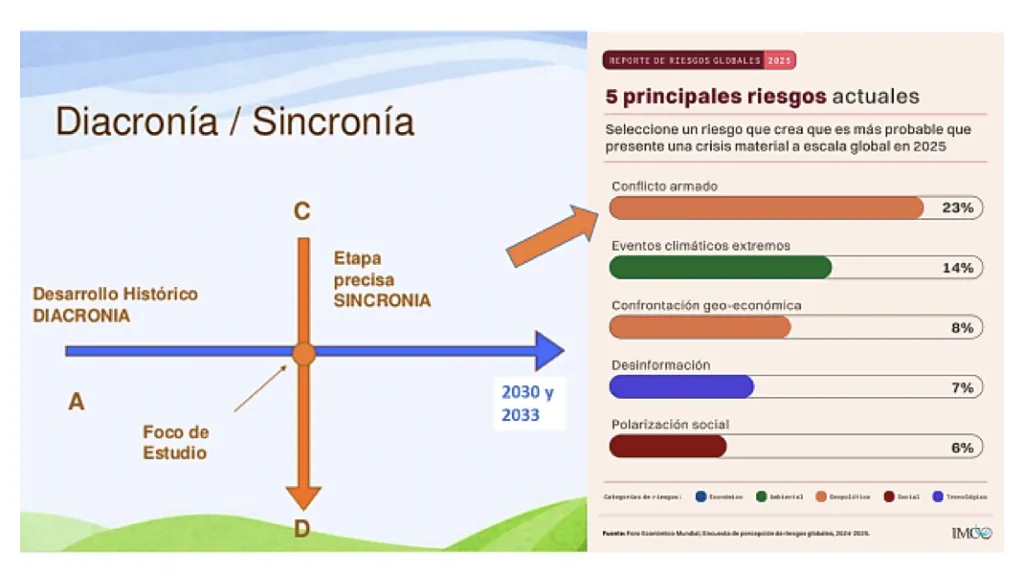
The methodology that allows us to know the futuribles and futurables for the conjunctural and long-term study, starts from the diachronic analysis (how it has been) towards the synchronic (how it is here and now) to prolong the gaze towards tomorrow.
Here and now
Globally, 23% of respondents identified armed conflicts as the main risk. This arises in the context of international conflicts such as the war in Ukraine and the conflict in Palestine-Israel. In addition to the violence of non-state organizations, such as organized violence, plays a role in these concerns.
Likewise, the report indicates that extreme weather events are recognized as an important risk. The consequences of these events are already being experienced around the world. Pollution and the use of fossil fuels make these disruptive events more frequent and, therefore, become a recurring anguish.
Thus, we test the methodology on how to act through the triad of knowledge, awareness and commitment, which are concepts related to communication, freedom, responsibility, and the choice of future.
In Mexico, respondents highlighted as the three main problems of the country:
-
The shortage of water supply.
-
Crime and illicit economic activity.
-
The shortage of energy supply.
These are followed by two social risks:
-
Poverty and inequality.
-
The insufficiency of public services and social protections.
Towards 2035, the report highlights:
-
Environmental risks as a central concern.
-
Extreme weather events, followed by loss of biodiversity.
-
The collapse of ecosystems.
The influence of the different world powers over the rest of the countries has been changing and increasingly rapidly. This is the case of China that in 20 years predominates over Asia, Africa and South America. Looking ahead to 2035, the report calls on world leaders and decision-makers to foster dialogue and create strategies to reach a sustainable, safe and inclusive future.
More Articles
San Luis Potosí Analyzes Strategies to Strengthen Regional Industry Amidst USMCA
Sep 1, 2026
Strategy Launched to Enable Businesses in San Luis Potosí to Sell on TikTok
Aug 19, 2026

Aguascalientes Companies Target Halal Market
Aug 19, 2026

40-Hour Workweek in Mexico: Lessons from Spain, Colombia, the US, and Chile
Sep 8, 2026

Grupo Galería Accelerates Dunkin' Expansion in Monterrey: Antonio Barceló
Sep 10, 2026

Train Would Position San Luis Potosí as a Key Logistics Hub in Mexico
Sep 7, 2026