
Inclusive Development Index
Discover insights about inclusive development index and their relevance in today's dynamic business environment.
How is it possible to achieve globalization with human dignity?
- Incorporating **human rights** into globalization by recognizing the human dignity of individuals.

- Globalizing by breaking down borders, **unifying societies** and upholding equality and justice.

- Globalization should **allow access to larger markets**, capital flows, technology, cheaper imports, and larger export markets.
Why Inclusive Development Is Necessary740
- Inclusive development requires **putting the person at the center** and uniting wills and capabilities.

- Inclusive development requires that **scientific-technical advances be equitable**. That is, that everyone has equal access to what they are entitled to.

- Inclusive development requires that economic growth translates into **greater freedoms and opportunities** for people.
Challenges of Current Globalization
Current globalization is not equitable. This has led to crises of moral, cultural and political values, and to the loss of traditional values of human communities.
- **Comparative**. The index allows comparisons between countries and regions, as well as over a period of time.

- **Integral**. The inclusivity index encompasses the social, ecological, ethical, and economic dimensions of development.

- **Verifiable**. The index is based on existing data and indices, ensuring its validity and reliability.

- **Transparent**. The methodology for creating the index is transparent and open to scrutiny, promoting accountability and trust.

- **Applicable**. The index can be used to identify the strengths and weaknesses of a country's approach to inclusive development, informing policy interventions.
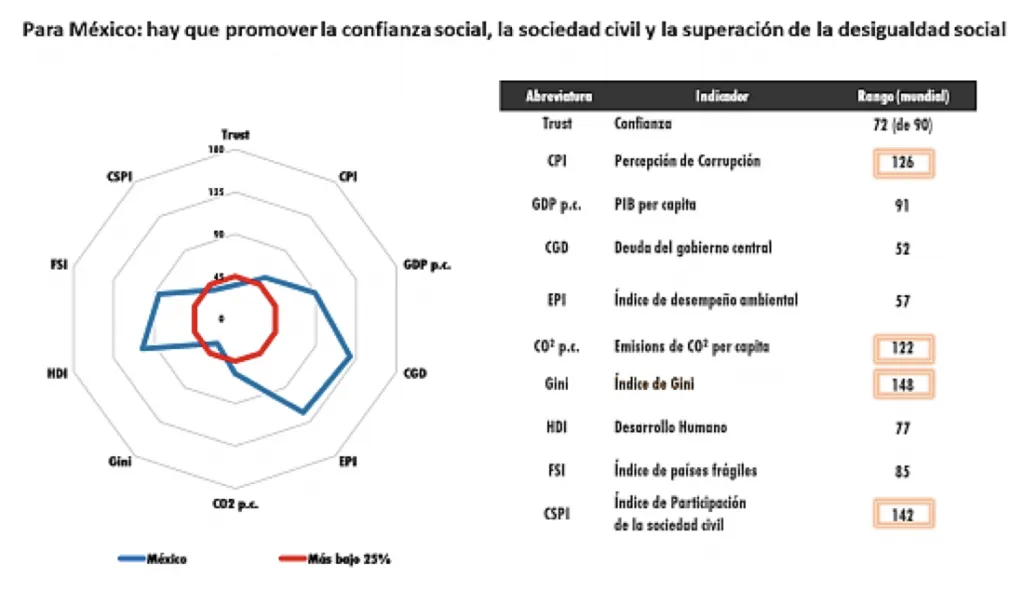
For the specific case of Mexico, and according to the inclusivity index, the conditions to guarantee access to the same rights, opportunities and resources for all have not been met, due to a lack of a participatory society, a better distribution of resources, and high levels of corruption and distrust.
The Gini coefficient is the most widely used method to measure inequality. It is an analytical tool that is often used to assess the concentration of income among the inhabitants of a country or region, in a specific period of time.
The member countries of the Asia-Pacific Economic Cooperation (APEC) Forum are: Australia, Brunei, Canada, Chile, People’s Republic of China, United States, Philippines, Hong Kong, Indonesia, Japan and South Korea. Also: Malaysia, Mexico, New Zealand, Papua New Guinea, Peru, Russia, Singapore, Thailand, Taiwan and Vietnam.
The Inclusivity Index separates them between countries in equilibrium (11) and critical countries (10), among which Mexico stands out with 0.666 points.
You May Also Be Interested In…
More Articles

Guanajuato Ranks in National Top 3 for Museums and Visitors
May 19, 2026

Aguascalientes Strengthens International Presence in Washington; Tere Jiménez Receives Bilateral Recognition
May 20, 2026

Why Greenwashing is a Risk for Mexican Companies and What is Changing
Jun 1, 2026

Fibra Mty Completes Acquisition of Fibra Macquarie: What Changes Will It Bring?
Jun 3, 2026

Tec de Monterrey Campus SLP: Cultivating Strategists for the Creative Economy
Jun 4, 2026

GPTW Certified Companies 2026: Labor Practices Transforming the Employee Experience
May 15, 2026